
"Everything is Connected"
Wild Women's feminist values episode!, TWO webinars, TWO books, and Ruth Asawa

Good morning, lovely humans. It is FEBRUARY or, in the timeless words of a Garfield puzzle I procured for 25 cents at a garage sale when I was 9 yrs old: “February is the armpit of the year.” Thank me later for just focusing on the February theme in this post.
Amidst it all, I’m heartened by Kim Carfore’s Ground Rules and Vision episode on “Return to the Fire”: 19 minutes about how feminist values (from Plumwood to Starhawk to Levinas) shape her approach and goals.
5 awesome tenets! Take a listen. Here’s one: Power With instead of Power Over.
Power with is a mutual amplification toward goodness: solidarity movements, constructive coalitions, mutual aid, communities of care. It is a stark contrast to fascist demonstrations of power over.
As Pranay Somayajula writes of Minneapolis in The Drift’s newsletter:
“Expressions of solidarity have become a feature of daily life in the Twin Cities. Neighborhood meetings in which people have learned how to create hyperlocal community defense and support infrastructure have drawn hundreds and packed overflow rooms in churches and schools across the Twin Cities. Networks have come together to coordinate accompaniment, carpooling, and grocery delivery for vulnerable neighbors, and every day community members stand watch outside local schools during arrival and dismissal times. Several times, when I’ve driven through my neighborhood in pursuit of an ICE vehicle, honking and blowing a whistle out the window to draw attention, I’ve been joined by onlookers in their own cars or following on foot, who whistle alongside me or film the agents. In the shared project of defending our home, each of us has a role to play.”
Later, Somayajula adds: “I have become increasingly convinced that rather than asking people what radicalized them — a familiar question for anyone who has spent time in left activist circles — a better query would be: what protagonized you?”
For values to guide protagonistic living, listen to Kim’s episode.
Wed, Feb 11, 7:00 pm ET: Zenner on “AI and Environmental Impacts” (webinar)
In the attention economy — where tech corporations aim to create addicts, i.e., users who relentlessly scroll and “engage” online — AI’s main competition is real-life-human relationships. Rebecca Solnit’s piece is on point: “What Technology Takes from Us—And How to Take it Back.”
What is the reality and what can we do? These two questions animate “Environmental Impact and AI: Hidden Costs and Inequalities” — a 75-minute talk and Q/A with me that includes lessons from feminist philosophy of science, intersectional ecofeminism, Catholic social teaching, the precautionary principle …
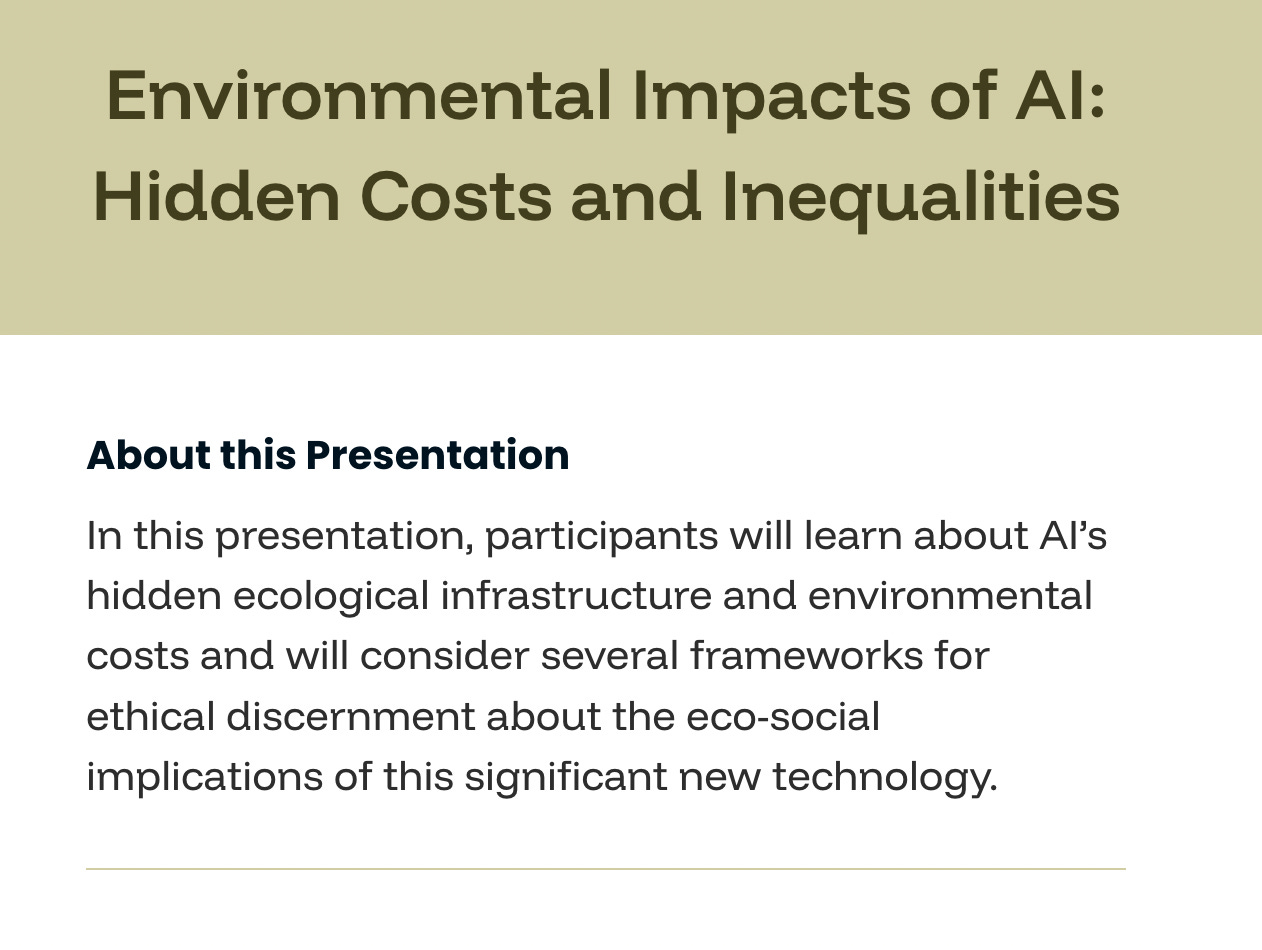
Aligned with the Building a Moral Economy project, we’ll explore the situation and what we can do. This is not a “muse about the singularity” kind of talk. (As the late Roger Haight once wrote on one of my grad school papers: “Christiana, if knowing weren’t for doing, I don’t know what it would be for.”)
Co-protagonist / erudite organizer / leader among wine moms … Kelly Clancy just launched her newsletter on AI resistance — and you should subscribe: “We, the AI Resistance, are Winning.”
Thu, Feb 12, 9:30 pm ET: “Wild Women and Just Water”
Academic protagonists converge! Dr. Carfore and I will be in conversation with each other and host Dr. Joseph Wiebe on February 12, 9:30 pm ET (7:30 pm MT). It’s livestreamed. Register here.
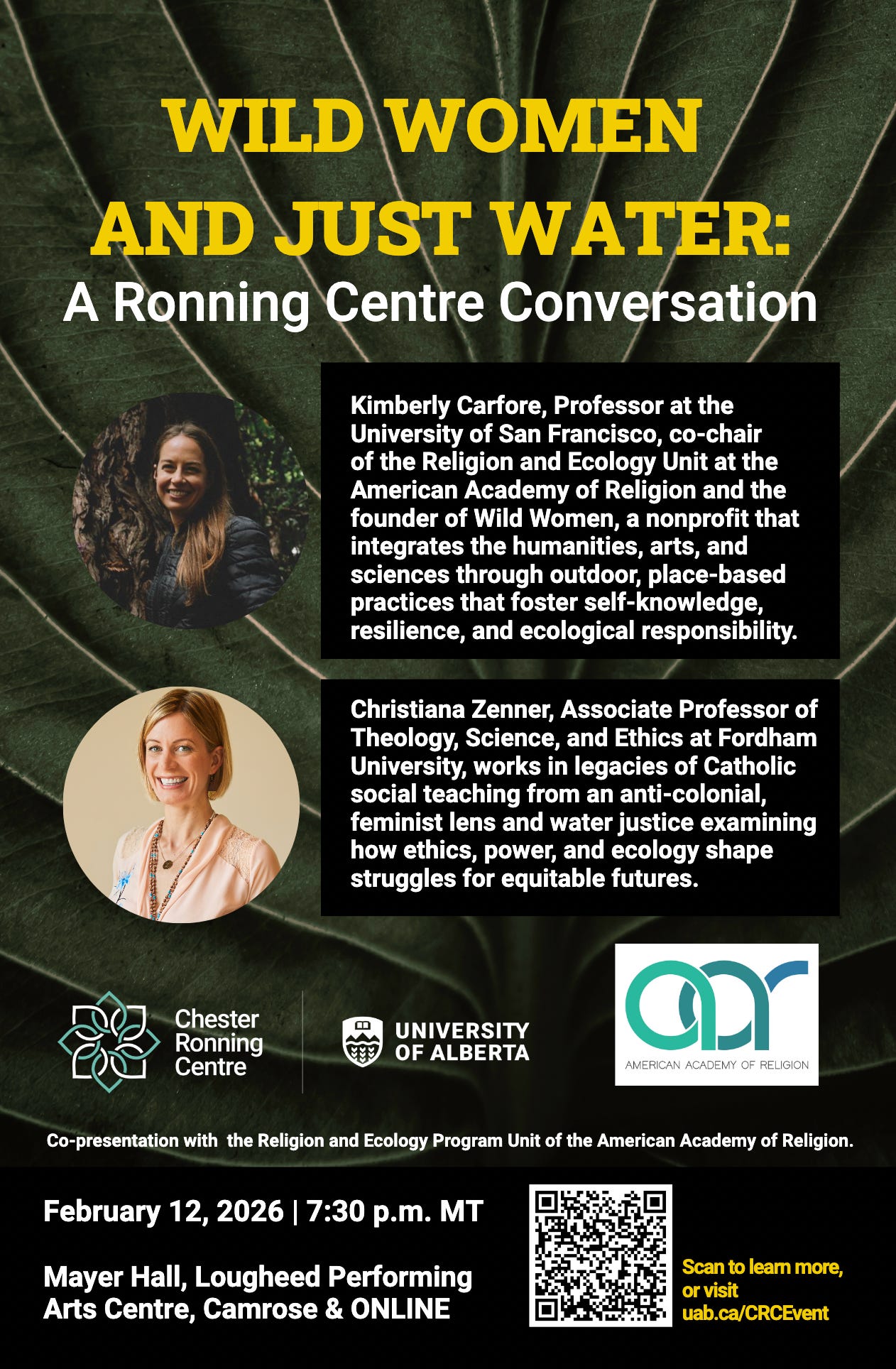
^ Kinda wanted to distribute Wet N’Wild chapsticks, but 1992 said no. As a result I did not pitch it formally to our academic sponsors
February 12 is Charles Darwin’s birthday—AND Kathy’s! Shout out to my baddies. Fun fact: Darwin and Abraham Lincoln were born on the same day in the same year (1809).
Ruth Asawa
The Ruth Asawa retrospective at MoMA runs through TOMORROW, Sunday Feb 7. This exhibit—like the glorious retrospective of Pacita Abad’s work I saw last January in Toronto—invites you to wander through her dimensional artworks, her life phases, her modes of creation. If you can’t go in person (and also if you can), watch this excellent 15-min video about Asawa’s six-decade career, an integrated practice of life and work.
I first learned about Ruth Asawa (1926 - 2013) in Cat Ricketts’ book, The Mother Artist. Ricketts’ thoughtful treatment of Asawa’s history and family life is a wonderful companion to the exhibit and film.
Californian by birth, Asawa and her family of origin were farmers. She and her family were incarcerated in an internment camp during World War II. She became an artist and 6 children.
Asawa made astonishing art—decisively moving sculpture off of the pedestal and into suspended wire forms: fractal in their precision, repetition, and invitation.
I learned from the video tribute that Asawa’s wire sculpture period overlapped exactly with birthing her six children. She started the Alvarado Arts Workshop to get arts curriculum into San Francisco Public Schools, her murals memorialize the Japanese internment camps, her late-life sketches of flowers trace the fine edges of petal and gift.
“Everything is connected,” Asawa insisted.
“I think that nature was her goddess,” reflected one of her sons.
“She says that she can make forms with a line that doesn’t steal the air from anyone,” said co-curator Cara Manes.
*
To create possibilities for other people and living beings, to see the world more porously and the connections between us more visibly, is not a skill that is highly rewarded in our contemporary late capitalist tech-driven milieu. But it is also what is essential about being human, and about the arts and humanities.
Make forms that don’t steal the air from anyone.
*
Emily Atkin at HEATED wrote last week in a quote that has been widely shared (by Ayana Elizabeth Johnson and NYC Climate Families among others):
“Climate change is state violence, too … The climate chaos we’re experiencing now, and what we will continue to experience, is a direct, conscious choice by the state to allow certain people to die. It kills through heatwaves, asthma, hunger, and displacement instead of bullets and batons, but the logic behind both is identical: certain people, mostly brown, can be sacrificed. I always need to remind myself that these are not two separate emergencies competing for attention, but one story unfolding on different timelines.”
Everything is connected.
Non-Identical Book Twins: Expected 2026
Pope Francis also often said, “everything is connected,” though long after Asawa phrased it. The phrase appears twice in Laudato Si’ (2015), frequently in his addresses, and in Laudate Deum (2023): “I repeat over and over again: ‘Everything is connected’…”.
Many (mostly Catholic) theologians have taken up the phrase to signal the intersecting domains of ecology, economy, society, morality — often linked with another concept that Francis popularized but did not invent: “integral ecology.”
I have a lot of thoughts on these kinds of phrases in LS and Catholic ecotheology/social teaching in light of The Broader World and academic discourses and lived philosophies like—oh yes—ecofeminisms, from which Francis could have learned great nuance on a range of intersectional points. And as you know if you read this missive:
Beyond Laudato Si’, where I talk about all of this and more, is coming June 2026. I AM SO EXCITED! It’s live on the website!
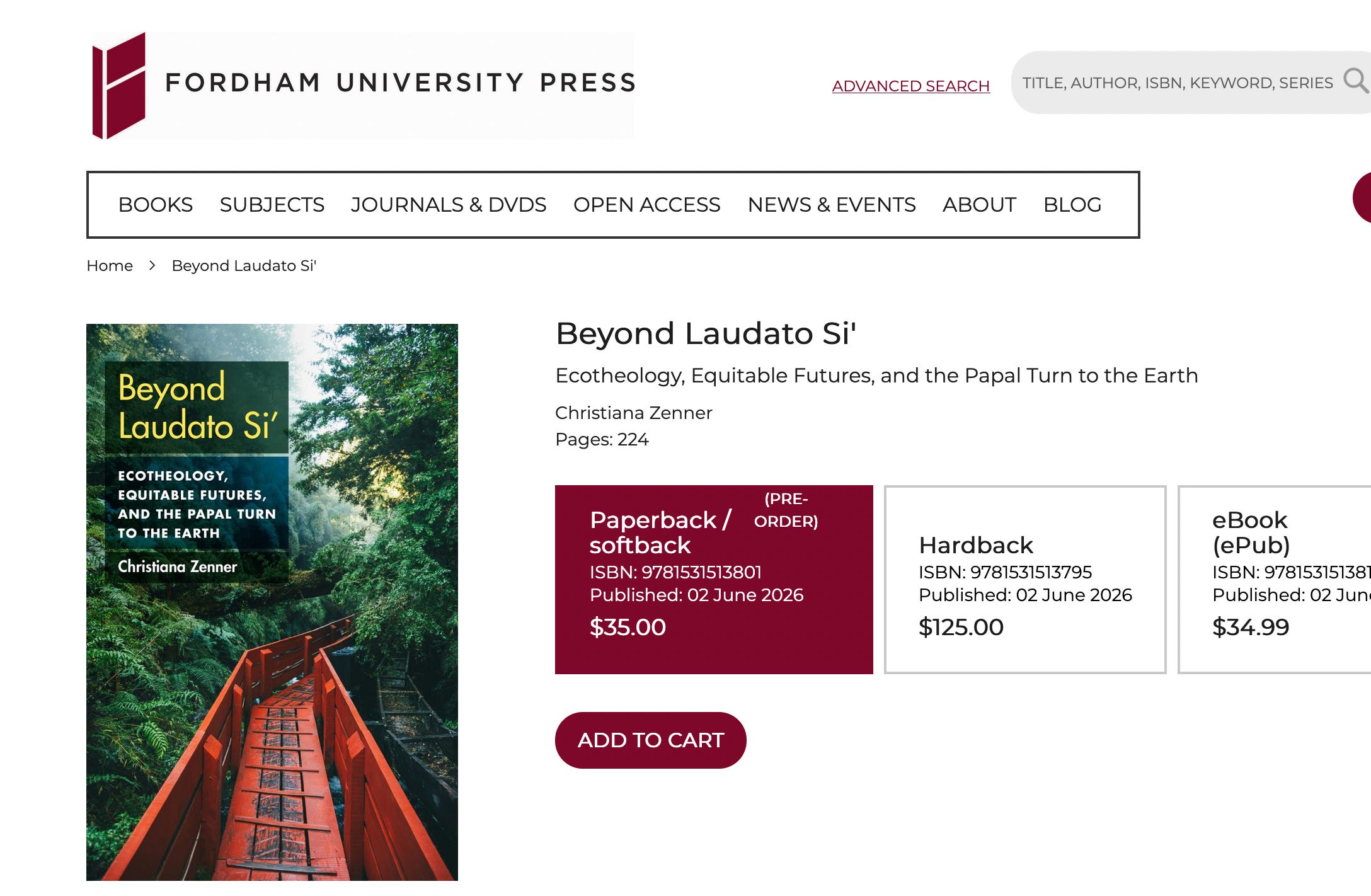
TABLE OF CONTENTS (insert dancer emoji here!):
Introduction: Beyond Laudato Si’
1. Origin Story and Main Claims of Laudato Si’ and Laudate Deum
2. Assessing the Impact of Laudato Si’
3. Theology and Science in the Catholic Church: From Galileo to Laudato Si’ and Laudate Deum
4. Integral Ecology: Alluring Concept, Critical Analyses
5. Sex, Gender, and Theological Abuse Culture in and Beyond Laudato Si’
6. The Turn to Indigenous Values and the Dangers of Colonial Reinscription
Conclusion
Wait, what? I thought you were writing Water for All …
So, yes, also. There are two books by yours truly forthcoming in 2026.
The first is Beyond Laudato Si’ (June 2026) with Fordham UP.
The second is Water for All (October 2026) — in the Building a Moral Economy Series with Fortress Press.
I have been bouncing back and forth between these projects from week to week, so more than one friend has quite reasonably asked: “I can’t keep it straight, which are you working on right now?”
Another friend said: “Two books … Zenner, it’s like you’re trying to one-up yourself!”
Yeah. That landed. It’s a modest bit of delightful-absurd.
At the same time, these are books that have gestated for a really long time (a decade+). AND CRUCIALLY: the conditions of my recent life have made it possible—about which more shortly.
But yes: when I commit to the bit, I really commit … as another friend pointed out when I sent her this photo. Please enjoy the beautiful, snowy elegance of February in NYC:
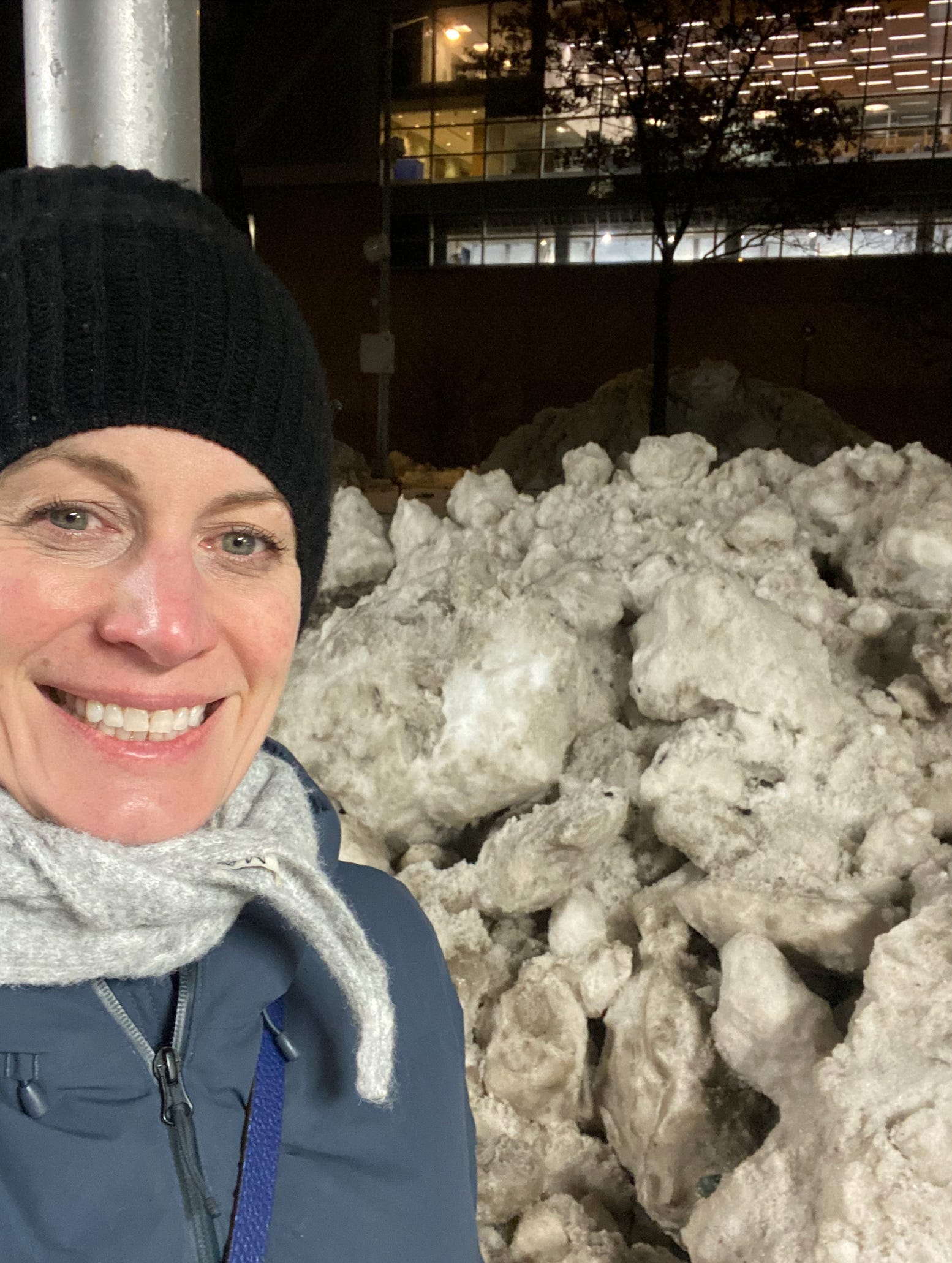
^ committing to the bit. Snowfall, many mornings after
These books have only been possible for me to complete this year because my life infrastructure has radically shifted. First and foremost, I am on a research leave aka sabbatical and so am not teaching. Second (related), as a result of that plus moving out of Westchester, I am no longer spending three hours per day on a commute. (Bonus: Living closer to friends; laughing more.) Third, since kiddo is in college, I am not waking at 5:32am to DoAllTheNeedfulThingsEfficientlyBeforeSunrise then ninja-warrioring through the day before collapsing into bed, probably next to a pile of unfolded clothes (Laundry Mountain), at 11:12 pm.
Infrastructure matters for snow removal, laundry mountain, parenting, professoring, and writing books. I have written/talked about this for years with regard to fresh water and sanitation conditioning the possibilities of women’s and girls’ education and equity. It is also true in societies that have plumbing and semi-reliable water supply. Infrastructure makes so much possible. Grit alone is not enough.
Make the invisible visible.
Achievements are not abstract matters of grit. The Economic Times (what even is that? idk) recently posted this contextless quote from Marie Curie and an interpretation of its significance:
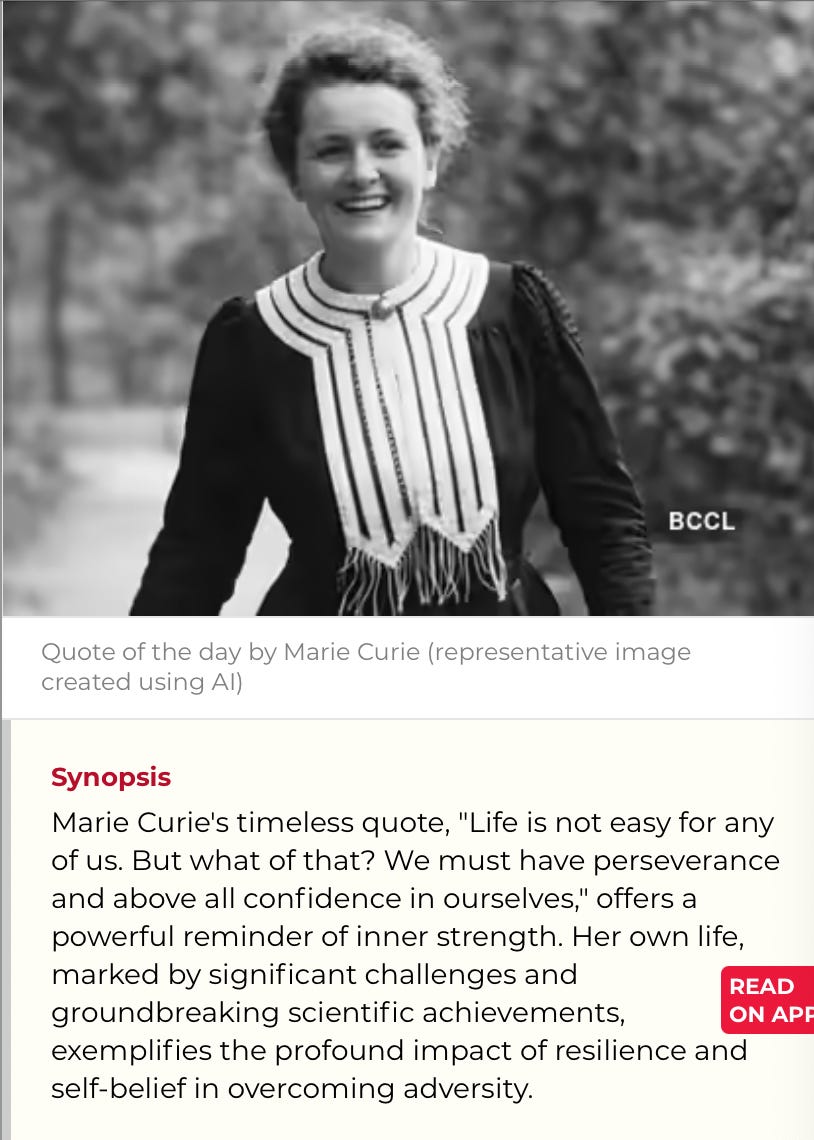
Yes to this and also, no. Belief alone is not enough. (Sorry, Luther.) Resilience! Adversity! Grit! Self-belief! Yes! And also, Childcare! Water! Research support! Health care! INFRASTRUCTURE!
Marie Curie left her children in the care of others for weeks at a time while she was researching and of course had help at home on the regular. (Presumably no one wondered how Pierre balanced it all.)
Now, I am no Marie Curie, but as I wrote in the Acknowledgements to Beyond Laudato Si’: “Major portions of this book would not exist without institutional support” provided by my employer—in the form of faculty research grants, tenured employment, and more. Broadening the frame, here’s what I wrote in the Acknowledgements to Water for All:
“Deeply exploitative neoliberal patterns govern much of the gig economy and higher education in a time of heightened pressure, surveillance, and demolition of the rule of law in the United States. In this matrix, I occupy a privileged and ever-less-numerous job as a tenured professor with job security and academic freedom (so far as it goes). It is well attested in democratic as well as fascist states that educational institutions and systems with guarantees of academic freedom are bulwarks of democratic, civic engagement and investments in the common good. I write knowing that two kinds of public goods that are dear to my heart and essential for healthy lives are under major peril: water and education. As it goes with water, so too with education: not every investment turns a direct profit – nor should it. Our moral vernacular is impoverished when economic value determines the discourse. I am grateful for all who work toward the recentralizing of valuable goods like water and education, in whatever ways you can.”
Power with, not power over.
Create forms of flow, not domination.
*
Until next time, friends:
Have courage
Be kind
Support the causes (you can find them everywhere)
Join the webinars if you’d like (Feb 11 and Feb 12)
And try not to almost-throw-out-your-back while putting on socks, as I nearly did yesterday. #MiddleAges
See you in two weeks. ~ CNZ